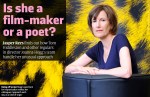
“Is she a film-maker or a poet?" Jasper Rees finds out how Tom Hiddleston and other regulars in director Joanna Hogg’s team handle her unusual approach – The Sunday Times April 27, 2014
Joanna Hogg normally shoots in houses, but one evening during the production of her new film, Exhibition, she is out in the field, on the plaza in front of the National Gallery. A skeletal crew records a small scene in which a woman walks up to a busker and watches as, out of the bell of his tuba, fireballs fly with each parp. Within minutes, the shot is in the can and barely a pedestrian has noticed.
Hogg’s seemingly effortless films ask the audience to look for the currents churning fiercely beneath a placid English surface. It takes a lot of paddling to achieve that aesthetic, and a group of collaborators attuned to her methods.
“Joanna makes no promises about what exactly the drama will be,” says her producer, Gayle Griffiths, who contacted Hogg after being knocked sideways by her debut, Unrelated, in 2007. “I see my job as creating a space in which she can be as free as possible.” For the producer, that means raising finance despite a paucity of star names — Exhibition’s married, middle-aged artists are played by what might be termed “found actors” in the former punk rocker Viv Albertine and former YBA Liam Gillick — or even a script.
In fact, for Unrelated there actually was a script of sorts, recalls the actress Mary Roscoe, who in both that and Exhibition plays the disillusioned female protagonist’s friend. “I got a message saying, ‘Don’t bother to learn the lines completely. The script is a guide, but I’m more interested in your own voices.’ So I never looked at the script again.”
In the next two films, Hogg left out the dialogue altogether. “The script came in the form of a complex, long-form ‘treatment’,” says Tom Hiddleston, the only actor to appear in all three of Hogg’s films (he has a cameo as a smooth estate agent in Exhibition). “It reads like a novella in the present tense. Some passages can be simple descriptions; others can be almost poetic or oblique.”
Another of Hogg’s quirks is to shoot chronologically, possible only because she rarely strays far from a main location (in which the cast also lives) — a Tuscan villa in Unrelated, a holiday cottage on Tresco in Archipelago and, in Exhibition, a modernist Kensington house.
The actors have “long meetings about back story, how these people relate to each other”, Hiddleston says. Thus equipped, their task is to play out the scene using their own instincts as a handrail, sometimes in takes of gruelling length — 50 minutes, even. “Joanna is steering the ship and she can change direction at any time, but, by and large, each character knows where he or she is going. After a while, you get lost in the details of your character’s journey, and you lose objectivity.”
For Roscoe, Hogg is “the most invisible director I’ve ever worked with — until the moment comes where very gently she starts to guide you”. Often she will withhold information from one actor, in order to simulate the reality of surprise. On Exhibition, the childless woman played by Albertine faints at dinner with her neighbour (played by Roscoe), who talks without cease about her son. “I certainly didn’t know Viv was going to do that, and I thought because Viv and Liam had worked so hard, maybe Viv really is knackered and has collapsed. But I thought, keep going till you hear ‘cut’.”
Hogg has a similar relationship with collaborators behind the camera: a combination of complete trust in others and monomaniacal focus on a vision only she can see.
“It’s different from working with anybody else,” says the cinematographer Ed Rutherford, who joined her for Archipelago. “She doesn’t say, ‘This is what I want from you specifically.’ You approach each day as a kind of virgin.” Their daily meetings on Exhibition were all about locating the characters in the space — essentially the third character in a portrait of a marriage. While the director’s cinematic lodestars are noteworthy — Antonioni, Michael Haneke, Ozu, Roman Polanski’s Repulsion — Hogg can go off piste. “I remember her talking about Philip Larkin’s poem An Arundel Tomb,” says Rutherford, “about this couple in a suppliant state for perpetuity and this veneer of contented love that outlasts everything. She seeks to ignite that spark in me and make sure it’s burning.”
Hogg’s improvisatory style can be exhilarating, but also, according to her ever-present production designer, Stéphane Collonge, “very unusual and quite stressful because you can’t actually rely on the plan. Suddenly, I’ve got to materialise something that’s got to be absolutely right in two hours.”
The best way to get results is through what he calls “Method production design”, occupying the space in order to understand how it and its inhabitants interact. During Exhibition, for example, the striped brick architecture of Kensington started to find echoes in the design — in Albertine’s tops, in venetian blinds, in the way light falls in the house. “It became quite an element of the vocabulary: the more her character wants to stand up for herself and move away from the gilded cage, the more she becomes one with the environment.”
The only one of Hogg’s inner circle who doesn’t come on set is her editor, Helle le Fevre, who has cut all three films down from 100 hours of rushes. “When I’m watching the rushes, it’s always quite exciting,” she says, “because I don’t know what’s fully going to happen. I’m experiencing the film. Sometimes when cutting the film I’d be thinking of sculpture. It keeps you on your toes, trying to understand the characters.”
In short, le Fevre is Hogg’s first audience, invited to scope her story’s quiet inflections and discreet obliquities for what Hiddleston calls “the small details and the strange truths of domestic intimacy”.
“Joanna is fascinated by how emotions and dynamics within a household or relationship can shift and flow, like tides. Her films are about open ends and rough edges. The wide angle of her camera holds still on an odd, awkward moment that nobody saw coming, a sentence unfinished, a silence between unspoken thoughts.”
 He was elegance, walking arm in arm with a lie